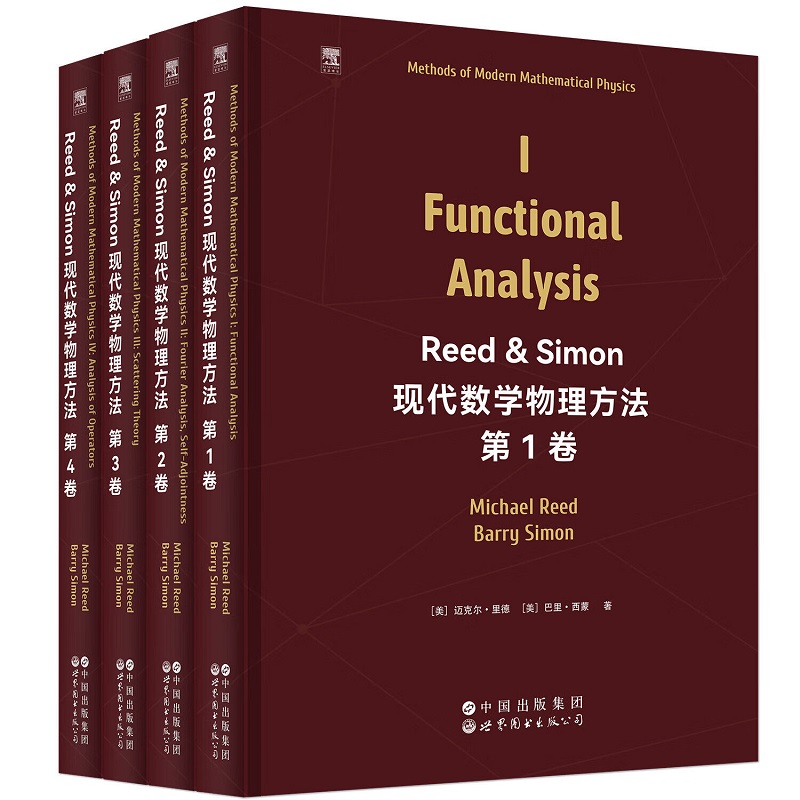
現代數學物理方法(全4卷)英文版
出版時間2025-11
作者:麥可·里德,巴里·西蒙
出版社:世界圖書出版有限公司
ISBN:9787523229453
開本:16
編輯推薦
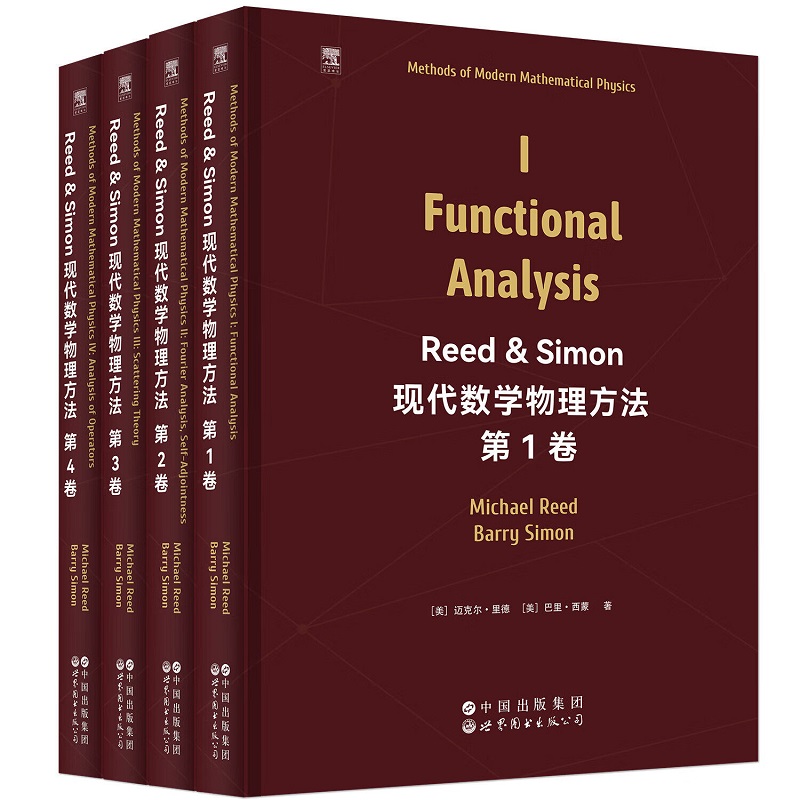
目前流行的所謂「數學物理方法」教材還是以復變函數、積分變換和數學物理方程式為主要內容。這些可以說是17-19世紀發展出來的數學物理方法,它們已經被很大限度地用於二十世紀的物理研究。現在大多數理工類學生都需要懂得這些方法。 Reed & Simon的這套書則可以說是二十世紀發展出來的新數學方法,是以量子力學為導向的泛函分析教學。
內容簡介
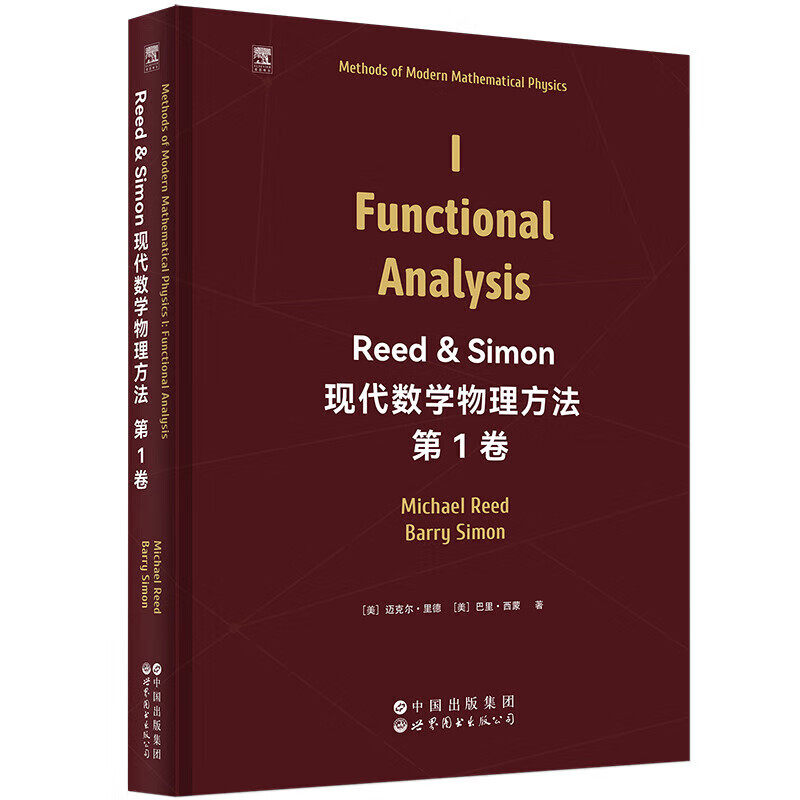
第1卷
本書是數學物理領域的傳世名著《現代數學物理方法》的第1卷,內容主要為泛函分析。這套書尤其突出“現代性”,講述數學家新發展的數學方法,幫助物理學家用於未來的物理研究。本系列以數學與理論物理學的交叉研究為核心,著重於現代分析方法在量子力學、散射理論等領域的應用。首卷以泛函分析為主線,系統闡述抽象測度、點集拓樸、局部凸空間等基礎理論,涵蓋Banach空間幾何與線性算子理論,形成自洽的教學架構。系列後續卷次圍繞散射理論展開,涉及經典粒子散射、量子多體散射、光譜分析及波動方程式等專題,結合Hilbert空間算子與相空間分析等數學工具,解析中心位勢場、量子場論等物理模型的理論架構。
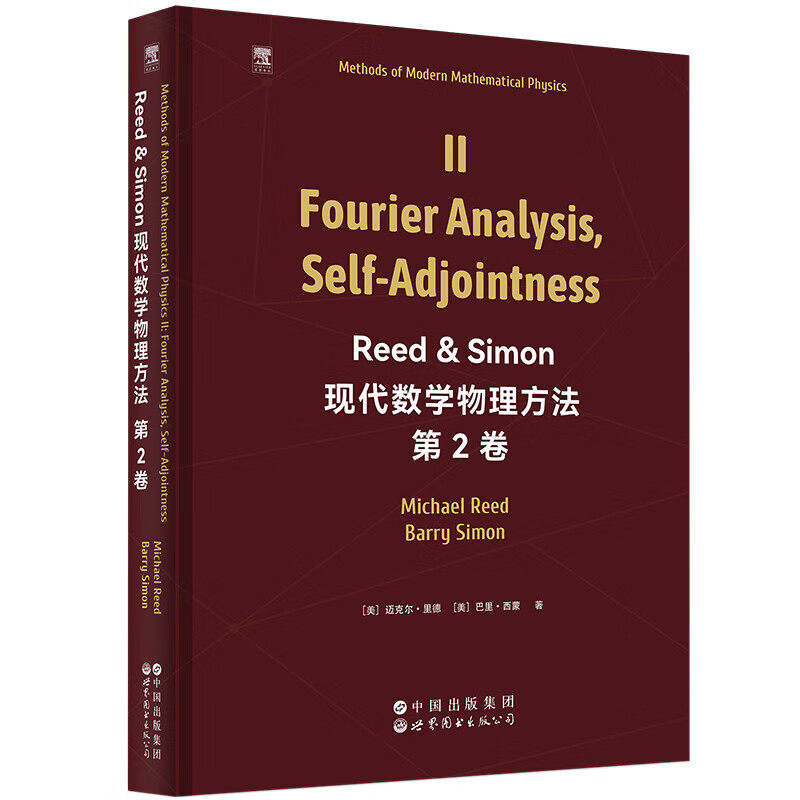
第2卷
本書是數學物理領域的傳世名著《現代數學物理方法》的第2卷,內容主要為傅立葉分析與自伴性。本系列以數學與理論物理學的交叉研究為核心,著重於現代分析方法在量子力學、散射理論等領域的應用。在第2卷中對量子力學中的數學技術和應用進行非常深入的討論,但僅對量子場論、經典力學和偏微分方程中出現的問題進行介紹。最後,本卷所發展的一些資料直到第3卷才會被應用。本卷涵蓋了各種各樣的主題。為了幫助讀者選擇對其重要的材料,在每章末尾都提供了「讀者指南」。
第3卷
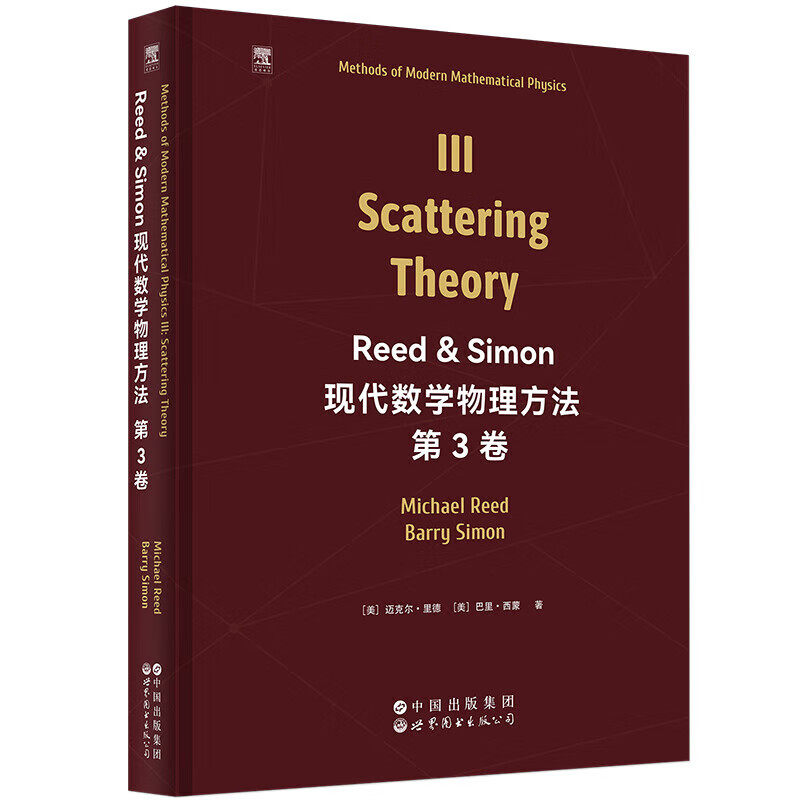
本書是數學物理領域的傳世名著《現代數學物理方法》的第3卷,內容主要為散射理論。本系列以數學與理論物理學的交叉研究為核心,著重於現代分析方法在量子力學、散射理論等領域的應用。自然界中存在著各種現象(例如天空的藍色),它們都是散射的結果。為了理解這些現象(並將其確定為散射的結果),必須了解背後的動力學及其散射理論。散射理論是研究相互作用系統,其時間和/或距離尺度遠大於相互作用本身的尺度。因此,它是研究微觀自然最有效的手段,有時甚至是唯一手段。本書著重將散射理論視為一種含時現象,特別是將相互作用動力學與自由動力學做比較。
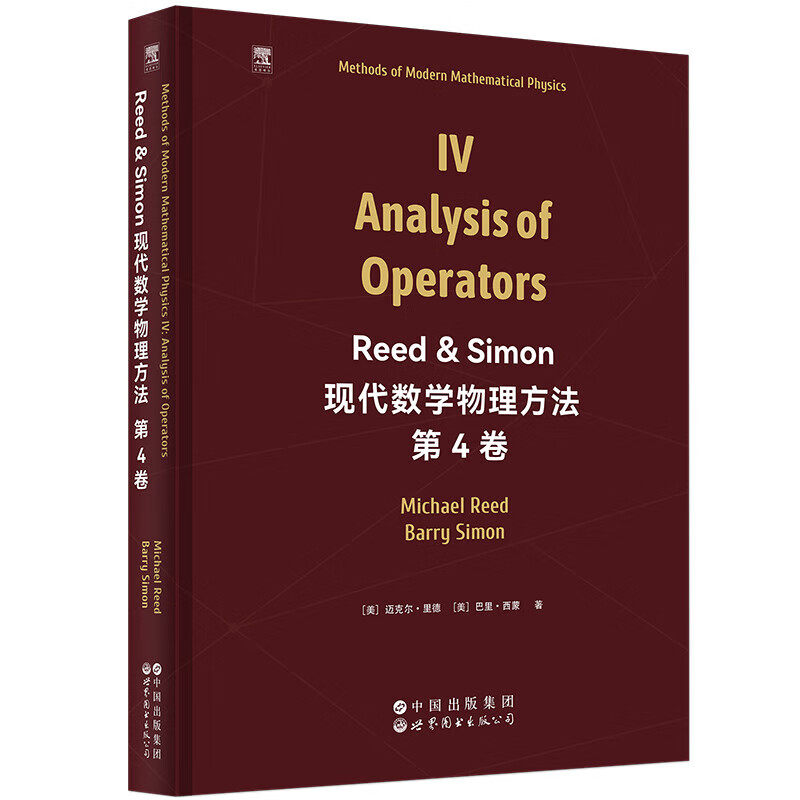
第4卷
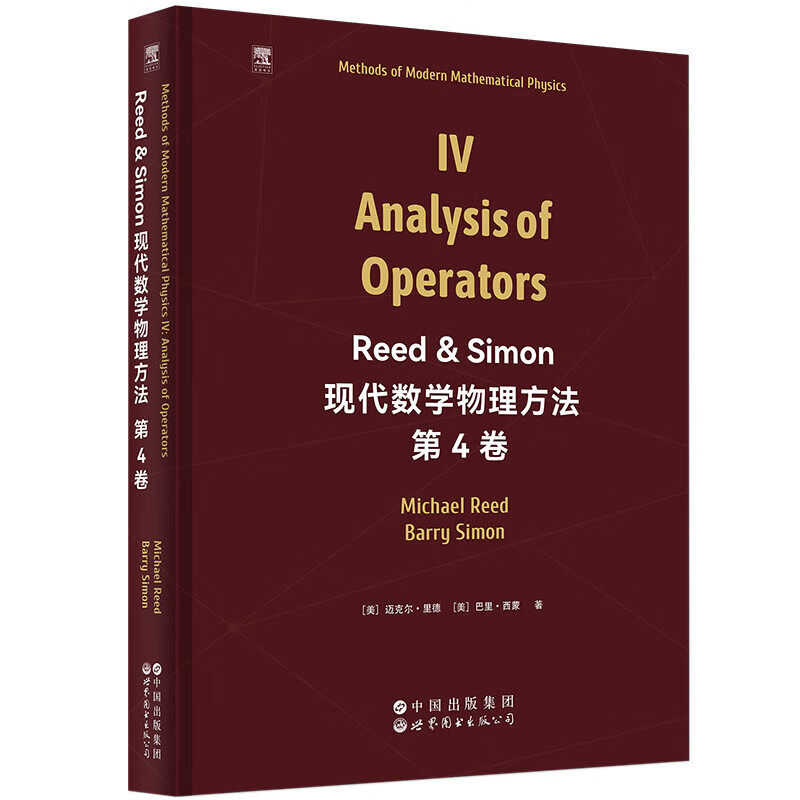
本書是數學物理領域的傳世名著《現代數學物理方法》的第4卷,內容主要為算子分析。本系列以數學與理論物理學的交叉研究為核心,著重於現代分析方法在量子力學、散射理論等領域的應用。對物理理論進行數學解釋的第一步,必須是解決該理論基本動力學和運動學方程式的存在性問題。一旦完成,人們就會想找到這些解決方案的一般定性特徵,並詳細研究物理感興趣的特定特殊系統。在討論了動力學存在性的普遍問題之後,作者在本卷及其配套的散射理論卷(第3卷)中提出了研究解的普遍定性特徵的方法。本卷中專注於非相對論量子力學的哈密頓量,但也探討了其他系統。
作者簡介
邁克爾·里德(Michael Reed)是美國杜克大學教授,因其對數學物理學和數學生物學的貢獻而聞名。巴瑞·西蒙(Barry Simon)是美國加州理工學院的教授,因其在譜理論、泛函分析和非相對論量子力學(尤其是薛丁格算子)方面的豐碩貢獻而聞名。
現代數學物理方法:第1卷(英文)
ISBN:9787523229453
出版社:世界圖書(北京)出版公司
作者:(美)麥可里德; (美)巴里西蒙
出版日:2025/11/01
裝訂/頁數:精裝/400頁
規格:24cm*17cm (高/寬)
版次:一版
現代數學物理方法:第2卷(英文)
ISBN:9787523229460
出版社:世界圖書(北京)出版公司
作者:(美)麥可里德; (美)巴里西蒙
出版日:2025/11/01
裝訂/頁數:精裝/361頁
規格:24cm*17cm (高/寬)
版次:一版
現代數學物理方法:第3卷(英文)
ISBN13:9787523229477
出版社:世界圖書(北京)出版公司
作者:(美)麥可里德; (美)巴里西蒙
出版日:2025/11/01
裝訂/頁數:精裝/463頁
規格:24cm*17cm (高/寬)
版次:一版
現代數學物理方法:第4卷(英文)
ISBN13:9787523229484
出版社:世界圖書(北京)出版公司
作者:(美)麥可里德; (美)巴里西蒙
出版日:2025/11/01
裝訂/頁數:精裝/396頁
規格:24cm*17cm (高/寬)
版次:一版
目錄
第1卷
I: PRELIMINARIES
1. Sets and functions
2. Metric and normed linear spaces
3. The Lebesgue integral
4. Abstract measure theory
5. Two convergence arguments
6. Equicontinuity
II: HILBERT SPACES
1. The geometry of Hilbert space
2. The Riesz lemma
3. Orthonormal bases
4. Tensor products of Hilbert spaces
5. Ergodic theory: an introduction
III: BANACH SPACES
1. Definition and examples
2. Duals and double duals
3. The Hahn-Banach theorem
4. Operations on Banach spaces
5. The Baire category theorem and its consequences
IV: TOPOLOGICAL SPACES
1. General notions
2. Nets and convergence
3. Compactness
4. Measure theory on compact spaces
5. Weak topologies on Banach spaces
V: LOCALLY CONVEX SPACES
1. General properties
2. Fréchet spaces
3. Functions of rapid decrease and the tempered distributions
4. Inductive limits: generalized functions and weak solutions of partial differential equations
5. Fixed point theorems
6. Applications of fixed point theorems
7. Topologies on locally convex spaces: duality theory and the strong dual topology
VI: BOUNDED OPERATORS
1. Topologies on bounded operators
2. Adjoints
3. The spectrum
4. Positive operators and the polar decomposition
5. Compact operators
6. The trace class and Hilbert-Schmidt ideals
VII: THE SPECTRAL THEOREM
1. The continuous functional calculus
2. The spectral measures
3. Spectral projections
4. Ergodic theory revisited: Koopmanism
VIII: UNBOUNDED OPERATORS
1. Domains, graphs, adjoints, and spectrum
2. Symmetric and self-adjoint operators: the basic criterion for self-adjointness
3. The spectral theorem
4. Stone's theorem
5. Formal manipulation is a touchy business: Nelson's example
6. Quadratic forms
7. Convergence of unbounded operators
8. The Trotter product formula
9. The polar decomposition for closed operators
10. Tensor products
11. Three mathematical problems in quantum mechanics
第2卷
IX: THE FOURIER TRANSFORM
1. The Fourier transform, convolutions
2. The range of the Fourier transform: Classical spaces
3. The range of the Fourier transform: Analyticity
4. L^p Estimates
5. Fundamental solutions of partial differential equations with constant coefficients
6. Elliptic regularity
7. The free Hamiltonian for nonrelativistic quantum mechanics
8. The Gärding-Wightman axioms
9. Restriction to submanifolds
10. Products of distributions, wave front sets, and oscillatory integrals
X: SELF-ADJOINTNESS AND THE EXISTENCE OF DYNAMICS
1. Extensions of symmetric operators
2. Perturbations of self-adjoint operators
3. Positivity and self-adjointness I: Quadratic forms
4. Positivity and self-adjointness I I: Pointwise positivity
5. Nelson's commutator theorem
6. Analytic vectors
7. Free quantum fields
8. Semigroups and their generators 235
9. Hypercontractive semigroups
10. Graph Limits
11. The Feynman-Kac formula
12. Time-dependent Hamiltonians
13. Classical nonlinear wave equations
14. The Hilbert space approach to classical mechanics
IX: THE FOURIER TRANSFORM
1. The Fourier transform, convolutions
2. The range of the Fourier transform: Classical spaces
3. The range of the Fourier transform: Analyticity
4. L^p Estimates
5. Fundamental solutions of partial differential equations with constant coefficients
6. Elliptic regularity
7. The free Hamiltonian for nonrelativistic quantum mechanics
8. The Gärding-Wightman axioms
9. Restriction to submanifolds
10. Products of distributions, wave front sets, and oscillatory integrals
X: SELF-ADJOINTNESS AND THE EXISTENCE OF DYNAMICS
1. Extensions of symmetric operators
2. Perturbations of self-adjoint operators
3. Positivity and self-adjointness I: Quadratic forms
4. Positivity and self-adjointness I I: Pointwise positivity
5. Nelson's commutator theorem
6. Analytic vectors
7. Free quantum fields
8. Semigroups and their generators 235
9. Hypercontractive semigroups
10. Graph Limits
11. The Feynman-Kac formula
12. Time-dependent Hamiltonians
13. Classical nonlinear wave equations
14. The Hilbert space approach to classical mechanics
第3卷
XI: SCATTERING THEORY
1. An overview of scattering phenomena
2. Classical particle scattering
3. The basic principles of scattering in Hubert space
4. Quantum scattering I: Two-body case
5. Quantum scattering II: N-body case
6. Quantum scattering III: Eigenfunction expansions
7. Quantum scattering IV: Dispersion relations
8. Quantum scattering V: Central potentials
9. Long-range potentials
10. Optical and acoustical scattering I: Schrödinger operator methods
11. Optical and acoustical scattering II: The Lax-Phillips method
12. The linear Boltzmann equation
13. Nonlinear wave equations
14. Spin wave scattering
15. Quantum field scattering I: The external
16. Quantum field scattering II: The Haag-Ruelle theory
17. Phase space analysis of scattering and spectral theory
第4卷
XII: PERTURBATION OF POINT SPECTRA
1. Finite-dimensional perturbation theory
2. Regular perturbation theory
3. Asymptotic perturbation theory
4. Summability methods in perturbation theory
5. Spectral concentration
6. Resonances and the Fermi golden rule
XIII: SPECTRAL ANALYSIS
1. The min-max principle
2. Bound states of Schrodinger operators I: Quantitative methods
3. Bound states of Schrodinger operators II: Qualitative theory
4. Locating the essential spectrum I: Weyl's theorem
5. Locating the essential spectrum III: The HVZ theorem
6. The absence of singular continuous spectrum I: General theory
7. The absence of singular continuous spectrum II: Smooth perturbations
8. The absence of singular continuous spectrum III: Weighted L² spaces
9. The spectrum of tensor products
10. The absence of singular continuous spectrum IV: Dilation analytic potentials
11. Properties of eigenfunctions
12. Nondegeneracy of the ground state
13. Absence of positive eigenvalues
14. Compactness criteria and operators with compact resolvent
15. The asymptotic distribution of eigenvalues
16. Schrodinger operators with periodic potentials
17. An introduction to the spectral theory of non-self-adjoint operators